The $2 Trillion USD Consensus: Crowded Longs and the Retail NatGas Squeeze
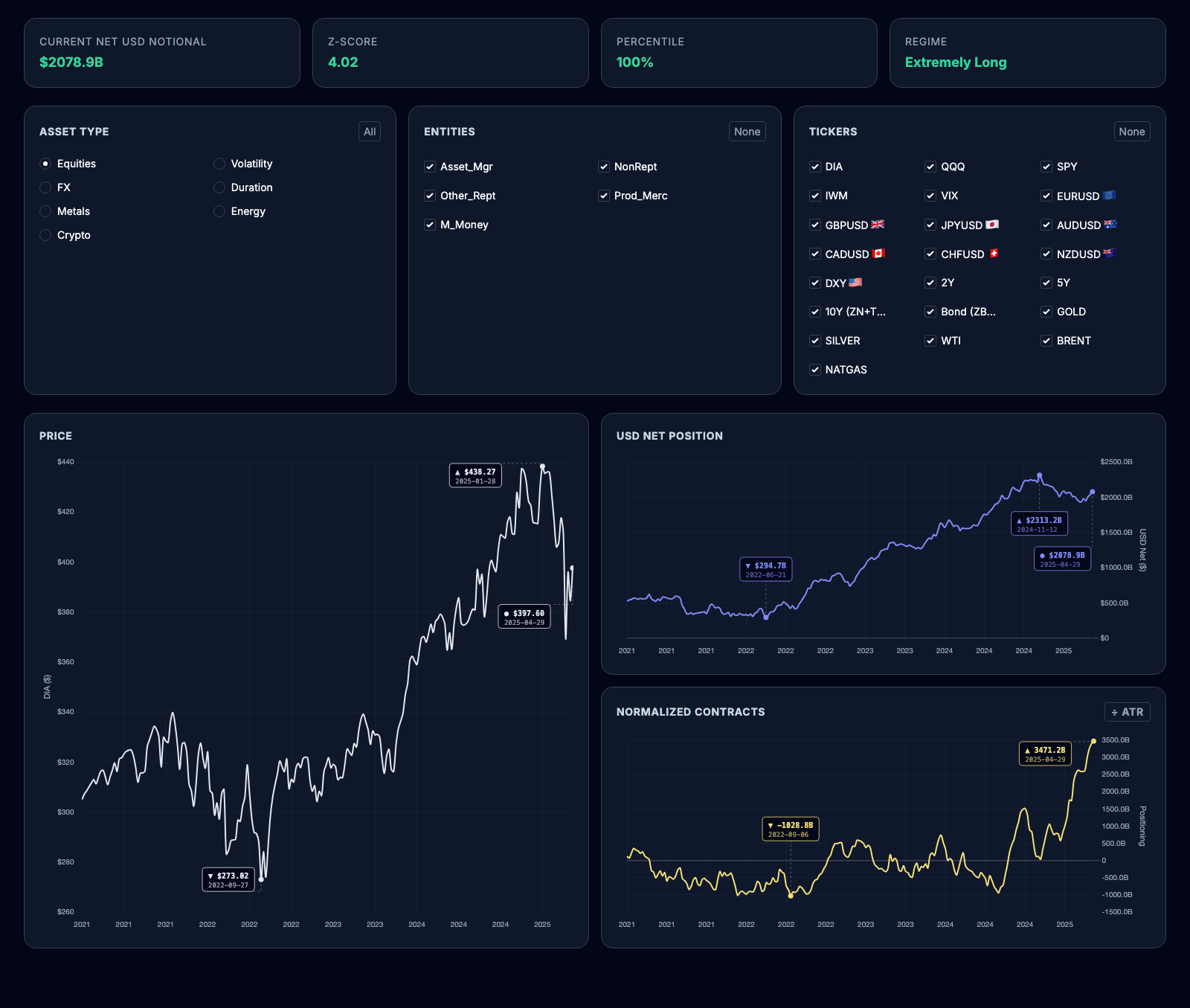
Aggregate USD net notional has reached a staggering $2.07 trillion, marking a 100th percentile extreme in the historical data set.
 gemini-3-flash-preview
Agency: 0 tool calls / 1 agents
Tokens: in 65K / out 4K / cached 0%
Run: cost $0.04 / time 24s
The $2 Trillion USD Long
The most striking feature of the current landscape is the $2.07 trillion aggregate USD net long position. This isn't just a local high; it is the 100th percentile of all historical readings. We are seeing a massive, multi-asset consensus where professionals and retail alike are positioned for a specific dollar-denominated regime. The last time we saw aggregate notional positioning this stretched was during the late-2024 peak, which preceded a significant period of volatility and mean reversion.
Duration Consensus and the JPY Reversal
The duration complex is equally crowded. Positioning in the 5Y and 10Y sectors is at the 100th and 99th percentiles, respectively. This suggests a total capitulation into the 'lower rates' narrative. Simultaneously, the JPYUSD long position has hit a 100th percentile extreme. This is a complete 180-degree flip from the multi-year carry trade shorts, indicating that the 'Yen strength' trade is now the most crowded room in the FX house.
Retail Divergences: NatGas and Equities
We are seeing significant divergences in the NonRept (retail) segment. Retail traders are currently 'Extremely Short' Natural Gas (0th percentile), a setup that historically precedes violent short squeezes. In equities, a notable split has emerged: retail is 'Very Short' the IWM (13th percentile) while remaining relatively neutral on the SPY and QQQ. This suggests retail is fading the small-cap rotation while professionals (Asset Managers) maintain their heavy long bias in large-caps.
- USD Dominance: The $2T notional peak suggests the 'Dollar Long' is the ultimate consensus trade.
- Duration Trap: With 5Y/10Y positioning at extremes, any hawkish surprise could trigger a massive liquidation.
- Energy Squeeze: Retail's record short in NatGas is the most asymmetric setup on the board for a bullish reversal.