Retail Fades the Small-Cap Rotation While Pros Corner the Long Duration Trade
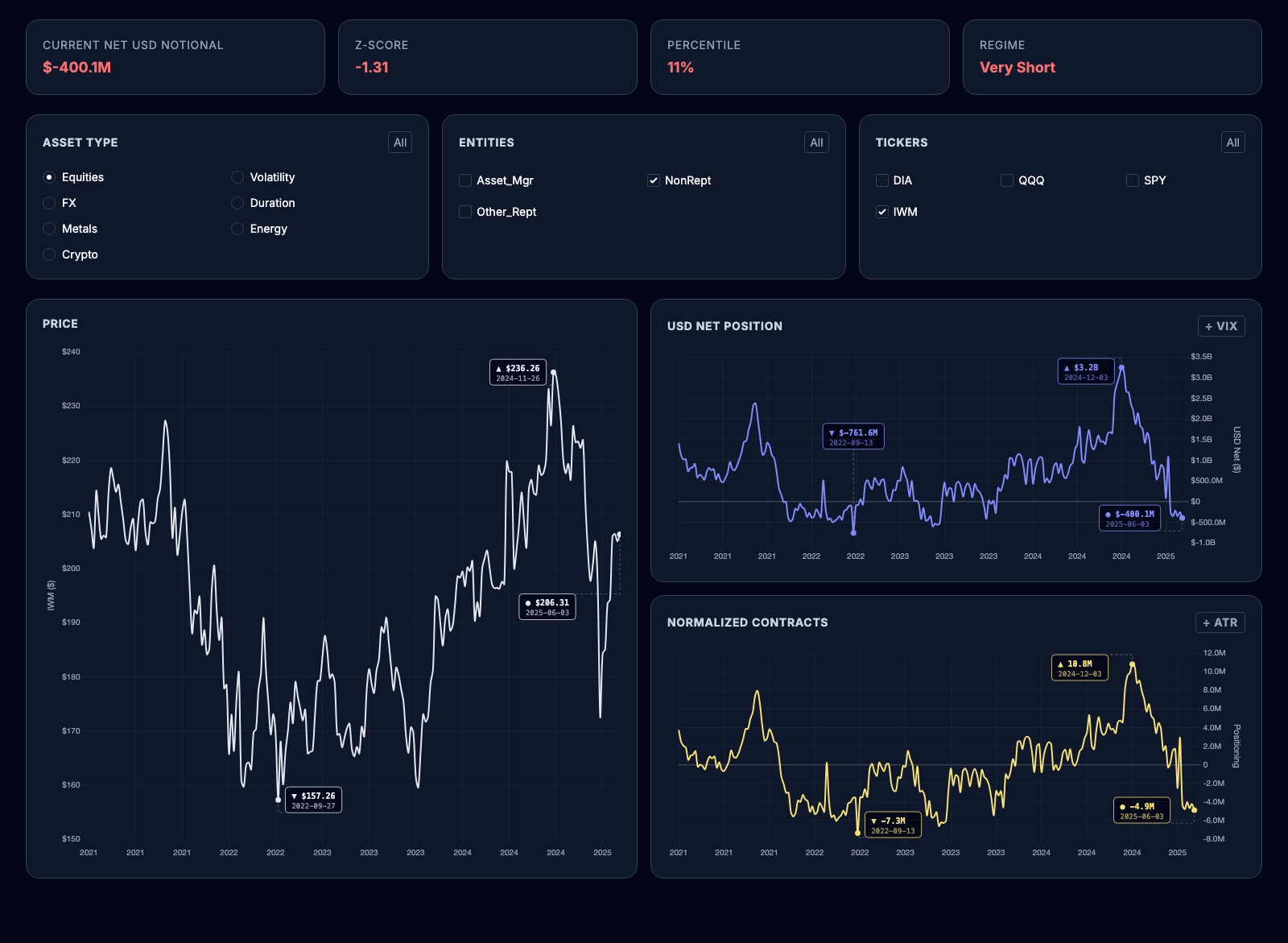
Retail positioning in IWM has collapsed to the 11th percentile, creating a massive contrarian divergence against the broader equity bid.
 gemini-3-flash-preview
Agency: 0 tool calls / 1 agents
Tokens: in 65K / out 4K / cached 0%
Run: cost $0.04 / time 23s
The Great Small-Cap Divergence
The most striking signal in the current landscape is the aggressive retail (NonRept) exit from IWM (Russell 2000). While the aggregate equity complex remains in a 'Moderately Long' regime, retail traders have pushed their net positioning into the 11th percentile. This 'Very Short' retail stance on small caps often serves as the fuel for a violent short squeeze, especially as Asset Managers maintain a more constructive baseline.
Duration Crowding Reaches Extremes
Professional positioning in the 10Y and 30Y (Bond) sectors has reached 'Very Long' territory, with the 10Y aggregate sitting at the 96th percentile. This is a professional 'cornering' of the duration trade, betting heavily on a disinflationary impulse or a policy pivot. Historically, when Other_Rept and Asset Managers are this aligned on duration, the market is vulnerable to a 'higher for longer' shock, yet the momentum remains firmly with the bulls for now.
FX Crowding: The Yen and Silver Traps
In the FX and Metals space, we are seeing dangerous levels of consensus. JPYUSD positioning is at the 99th percentile for retail, suggesting that the 'Yen recovery' trade is now the most crowded retail play on the board. Similarly, Silver aggregate positioning has hit the 99th percentile. When positioning reaches these terminal percentiles, the asset usually requires a fresh fundamental catalyst to avoid a mean-reversion flush.
Volatility and Energy: The Hedging Wall
- VIX: Retail is currently 'Very Long' (81st percentile), indicating a high cost of insurance and a general 'fear of heights' among smaller participants.
- Energy: A significant divergence exists in WTI and NatGas, where retail is 'Very Short' (4th and 5th percentiles respectively), providing a contrarian tailwind for a potential breakout in crude.