The $1.47 Trillion Duration Corner
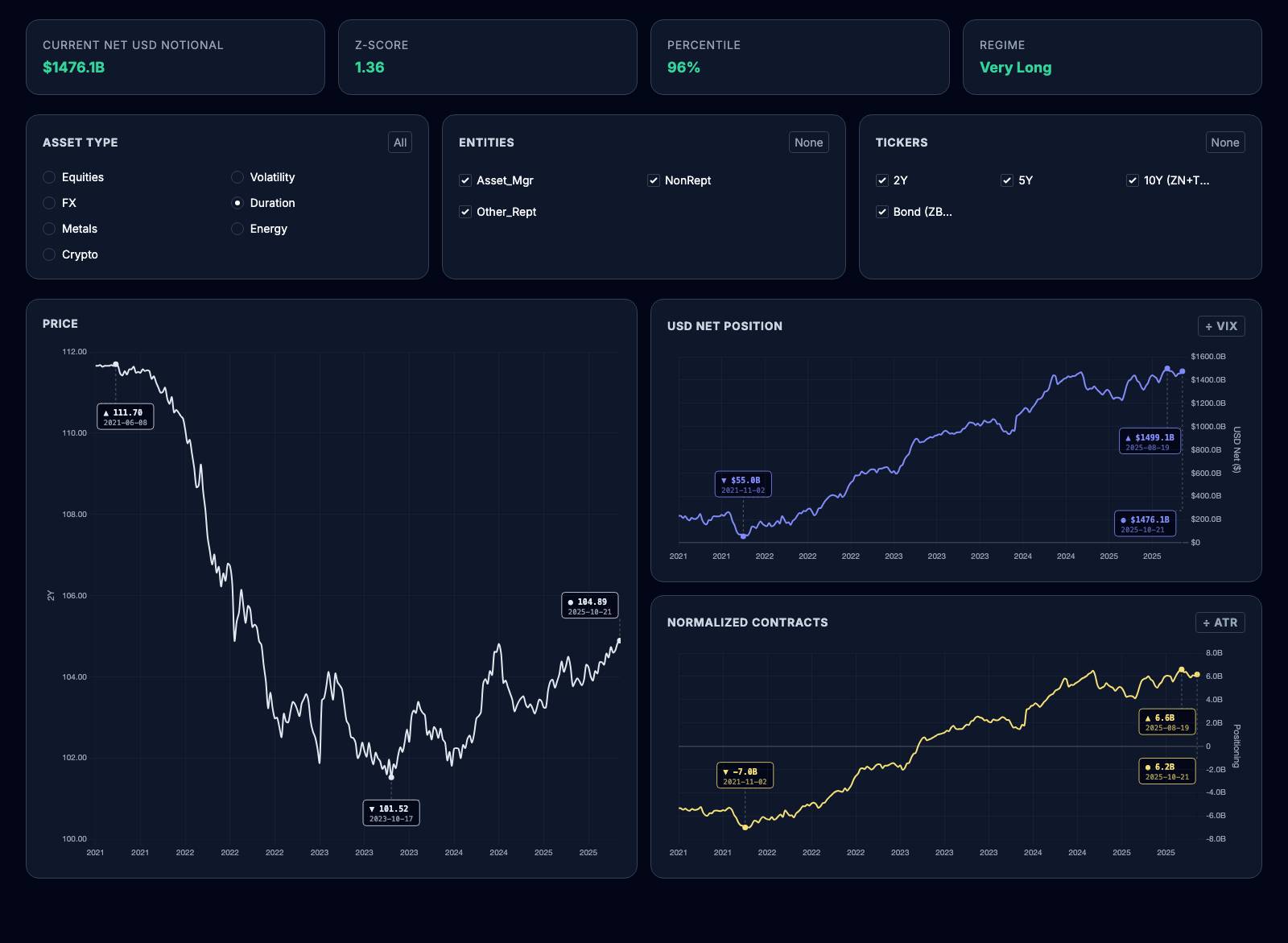
Aggregate duration positioning has ballooned to a staggering $1.47 trillion notional long, marking one of the most concentrated consensus bets in recent history.
 gemini-3-flash-preview
Agency: 0 tool calls / 1 agents
Tokens: in 65K / out 5K / cached 0%
Run: cost $0.05 / time 32s
The Duration Overcrowding
The most striking feature of the current landscape is the absolute dominance of the long duration trade. Across the curve, from the 2Y to the Ultra-Bond, aggregate positioning has reached a $1.47 trillion USD notional long. This isn't just a trend; it is a structural cornering of the market. We are seeing 100th percentile positioning in the Bond (ZB) complex, a setup that mirrors the feverish 'pivot' anticipation of late 2023 but with significantly more capital committed.
Retail vs. Professional Divergences
While the pros are anchored in duration, we are seeing fascinating divergences in the equity and metals space:
- Gold: NonRept (retail) length has hit a literal ceiling at the 100th percentile ($28.9B). Historically, when retail maxes out their notional capacity like this, the marginal buyer disappears, leaving the asset vulnerable to a sharp distribution phase.
- Equities: In SPY, retail length is at the 81st percentile, while the aggregate composite is lower at the 77th. Retail is effectively leading the charge into the current rally, while Asset Managers have subtly begun to trim net exposure.
- Energy: A massive contrarian signal is flashing in Natural Gas, where retail is 'Extremely Short' (3rd percentile). This positioning usually precedes a violent short-covering squeeze.
FX and the Short Dollar Consensus
The DXY is currently sitting in a 'Very Short' regime, fueled largely by massive long positions in JPY and EUR. The JPYUSD long position ($13.8B) is particularly notable, representing a 'Very Long' regime that suggests the carry trade unwind is still the primary driver of FX derivatives flows. However, the NZDUSD presents a unique divergence; it is currently in an 'Extremely Short' regime (-2.71 Z-Score), making it the most likely candidate for an aggressive mean-reversion rally if the USD continues to soften.